About one-third of service calls are already handled by AI, according to Salesforce’s November 2025 State of Service report, and that number will hit 50% by 2027. But what percentage of those calls are–or could be–resolved by AI without human intervention? That is an entirely different question.
AI agents are no longer just for enterprise. SMBs are adopting them to reduce costs, handle volume, and compete with larger
What Is an Agentic AI Agent for Customer Service?
Originally, AI agents were non-agentic, similar to chatbots and AI-powered support platforms. But the term gets used loosely, and the differences matter when you’re deciding what to buy:
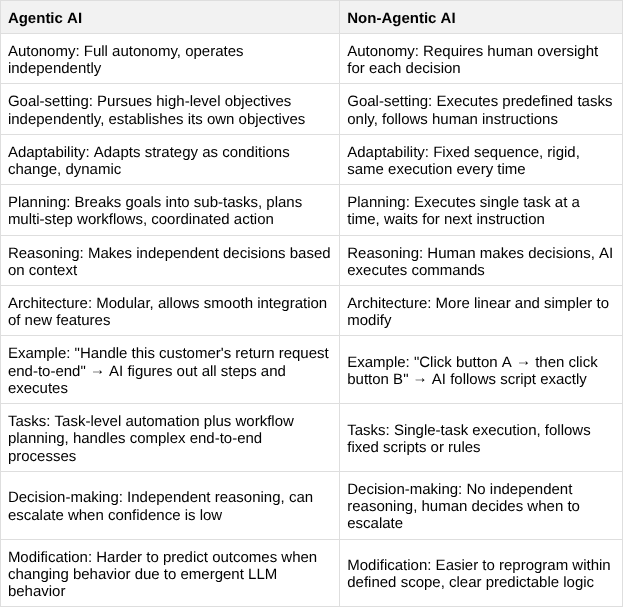
pferences Between Chatbots, AI-powered Support Platforms, and AI Agents
The term “AI agent” has a precise meaning in the industry, but you would not know it from browsing the market. True AI agents can reason through problems, take independent action, and complete multi-step tasks without a human directing each move.
Why SMBs Are Adopting AI Agents Now
Two-thirds of businesses that have already adopted AI agents report measurable productivity gains, according to PwC’s AI Agent Survey. More than half say they’re seeing real cost savings and faster decision-making. And 54% credit AI agents with improving the customer experience.
What to Look for When Choosing an AI Agent Platform
Knowing AI agents deliver results is one thing. Choosing the right platform is where most SMBs get stuck. Not all AI agent platforms are built the same, and the wrong choice can mean paying for capability you can’t use or getting locked into something you’ll outgrow. These six factors are worth evaluating before you commit to any platform:
1. Resolution Capability
The most important question to ask any vendor is whether their agent actually resolves issues or just routes them. Triaging a customer inquiry and handing it off to a human likely isn’t much of an upgrade over what you already have.
Look for platforms with documented resolution rates across real customer interactions, not just demo scenarios. That track record is the clearest signal of whether the AI is actually doing the work.
2. Omnichannel Support
Your customers aren’t reaching out through one channel, and your AI agent shouldn’t be limited to one either. A platform that handles chat but not email, or email but not voice, creates gaps that fall on your team to cover.
3. Ease of Use for Non-Technical Teams
If your support team needs to file a ticket with engineering every time they want to update the agent, the platform is going to create friction fast. The best platforms let support leaders configure, adjust, and retrain the agent themselves. That independence matters, especially for SMBs, where engineering resources are limited and support needs change quickly.
4. Integration with Existing Tools
An AI agent that can’t talk to your CRM, helpdesk, or knowledge base is working blind. It needs access to customer history, open tickets, and your existing documentation to give accurate, useful responses. Before committing to any platform, map out which tools it needs to connect to and verify those integrations exist and actually work, not just that they’re listed on a features page.